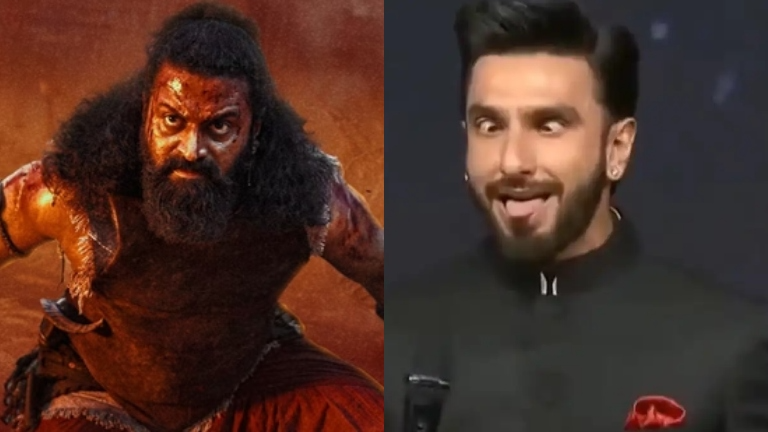
Weeks after Ranveer Singh apologised for mimicking daivas during an event, Kantara director and actor Rishab Shetty has spoken out about the controversy. He expressed his discomfort with others enacting aspects of his culture and tradition at an event.
Rishab Shetty REACTS To Ranveer Singh Mimicking Daivi
During a recent event by Behindwoods in Chennai, Shetty explained that daivas are considered sacred and should not be mocked or performed without proper guidance. “That makes me uncomfortable. While much of the film is cinematic and performative, the daiva element is sensitive and sacred. Wherever I go, I request people not to perform it on stage or imitate it. It is deeply emotional and connected to us,” he stated.
Although Shetty did not mention Ranveer Singh by name, his comments came shortly after Singh faced criticism for imitating the famous Chaundi scene from Kantara during a session at the International Film Festival of India (IFFI). Singh impersonated the character as a “female ghost,” crossed his eyes, stuck out his tongue, and added a “primordial scream,” with Shetty laughing beside him. Singh also joked, “Anybody here want to see me in Kantara 3? Tell this guy,” pointing at Shetty.
Ranveer’s Fans Respond Harshly To Rishab’s Reaction To The Controversy
Many online users felt that Rishab Shetty’s recent statement was an unnecessary attempt to reignite controversy over Ranveer Singh, despite his previous apology for what was described as a ‘misguided and ill-judged’ tribute. Sharing a news clipping of Rishab’s comments, one fan remarked, “If Daiva was upset about Ranveer Singh mimicking it, why did Dhurandhar go on to become such a huge hit?”
However, many criticized Rishab for bringing up the controversy again. “Rishabh and anyone with even a shred of common sense know that Ranveer never intended any harm. I don’t understand how people use divinity to police others’ morality! God doesn’t judge us for unintentional mistakes, so why do we?” argued one user. Another echoed this sentiment, saying, “Intentions matter. It was ignorance, not malicious intent.”
One comment stated, “Nobody gave Rishab Shetty special authority to mimic Daivanarthaka.” Another brought up the box office rivalry between Dhurandhar and Kantara, claiming, “He’s upset because Dhurandhar might beat Kantara Chapter 1’s record. Ranveer never mocked anyone.”
Ranveer Singh’s Apology
The video clip quickly went viral, drawing backlash from many netizens who felt it disrespected the cultural significance of the scene. Singh later issued an apology, stating, “I intended to highlight Rishabh’s incredible performance in the film. As an actor, I understand the effort it takes to perform that scene, and I have the utmost admiration for his work. I have always deeply respected every culture, tradition, and belief in our country. If I’ve hurt anyone’s sentiments, I sincerely apologise.”
Why Is The Chaundi Scene Considered Culturally Sensitive?
In Kantara, the Chaundi appears during a powerful, spiritually charged sequence. Portrayed as Guliga Daiva’s fierce and protective sister, the scene combines ritual movements, trance-like energy, and coastal folklore. All this makes it highly significant within Tulu and Bhoota Kola traditions. Her presence symbolises divine rage and ancestral spirit. It is why many viewers see any mockery of this portrayal as deeply disrespectful and culturally insensitive.
For more news and updates from the entertainment world, stay tuned to Bollywood Bubble.
Also Read: Ranveer Singh Apologises To Rishab Shetty For Mocking Kantara Chapter 1’s Daiva Scene; Says, “I Respect Every Culture, Tradition And Belief”

Akankshya Mukherjee is a dynamic and ambitious individual poised to make waves in the realm of Media and Communication. With a passion for creativity and a drive to contribute to forward-thinking organizations, Akankshya embodies adaptability and a hunger for learning. Having already garnered experience through involvement in various organizations, she has honed the skill of quickly adapting to new environments and challenges. She sees each opportunity as a chance for personal and professional growth, eagerly embracing roles in communications and content writing.
Related Posts
DYK, Divya Dutta Signed 20 Films But Stepped Back On Aditya Chopra’s Advice; Admits, “I Was Taken Aback”
Dhurandhar The Revenge: What If Ranveer Singh Starrer Was Made In Mollywood? AI Stars THESE Actors As Hamza Ali Mazari, Rehman Dakait, Yalina
Money Heist Fame Enrique Arce Wants To Watch Shah Rukh Khan, Aamir Khan’s Films; Reveals, “I’m Most Intrigued By Zindagi Na Milegi Dobara”
DYK, Aamir Khan Wanted Son Junaid Khan To Make Bollywood Debut With Ek Din; Sources Reveal Why
Recent Post
- Kritika Kamra- Gaurav Kapur Reception: Malaika Arora, Vidya Balan, Richa Chadda And Many Celebs Attend The Newlyweds’ Star-Studded Celebration

- Ramesh Taurani Diwali Party 2025: Hrithik Roshan-Saba Azad, Riteish-Genelia Deshmukh, Sonakshi Sinha-Zaheer Iqbal And Other Bollywood Celebs Glam Up Ahead Of Festivities
- Manish Malhotra Diwali Party 2025: Nita Ambani, Radhika Merchant, Kareena Kapoor, Karan Johar And Other Bollywood Celebs Dazzle In Their Festive Finest

- The Ba***ds Of Bollywood Screening: Ranbir Kapoor-Alia Bhatt, Vicky Kaushal, Ambanis And Many More Celebs Step Out In Style To Support Aryan Khan’s Directorial Debut

- Son Of Sardaar 2 Screening: Mrunal Thakur, Ravi Kishan, Kubbra Sait, And Other Bollywood Celebs Attend Ajay Devgn’s Comedy Drama Premiere
- Metro…In Dino Screening: Aditya Roy Kapur, Sara Ali Khan, Anupam Kher, Neena Gupta And Other Bollywood Celebs Attend Anurag Basu’s Romantic Drama Premiere
- Naagin 6 Fame Simba Nagpal’s THESE Photos Prove He’s The Ultimate Adventure Junkie
- Met Gala 2025 Worst Dressed: ‘Basic’ Hailey Bieber To ‘Barbie’ Shakira And ‘Witchy’ Sadie Sink, 12 Celebs Who Pissed The Fashion Police

- Met Gala 2025 Best Dressed: Pregnant Rihanna To Princey Diljit Dosanjh And Mesmerizing Jodie Turner-Smith, 12 Celebs Who Wowed Us With Their Fashion
- Phule Special Screening: Javed Akhtar, Rajkummar Rao, Huma Qureshi And Other Celebs Arrive To Support Pratik Gandhi, Patralekhaa-Led Biopic
Read More
Follow us
© 2026. All rights are reserved with DeepDive Digital Pvt Ltd