

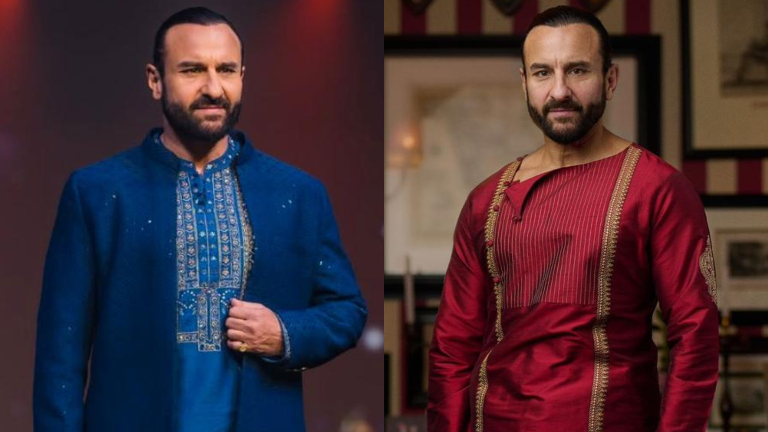
Indian Cinema has witnessed evolving eras throughout which Saif Ali Khan has served perfection in each one of them. In an industry that resists change, Saif’s journey is all about defying expectations at every step. While the realm boasts actors who have made themselves comfortable in a certain narrative. Saif Ali Khan has explored shades of cinema and acting. Transitioning from the soft boy era of the 2000s to a bold risk-taker in the theatrical and digital space. His knack for exploring the ‘actor’ element with each project has cemented him as one of the most versatile and rare actors of Bollywood. Making him the ‘Nawab’ of cinema exploration in its truest form.
Saif Ali Khan Throughout The Years
Saif Ali Khan’s vibrant filmography proves that he never confined himself to the typical archetypes of playing the typical action hero, romantic lead, or larger-than-life portrayal. He stayed a step ahead by crafting a filmography that spans mainstream blockbusters, thrilling web dramas, and delving into dark indie explorations. His filmography can be studied in three different phases where he has always ditched the industry norms of confinement to bring freshness to the screens.
Saif Ali Khan cemented himself as the face of contemporary romances right from the 1990s and early 2000s with classic rom-coms like Hum Tum, Kal Ho Naa Ho, and Salaam Namaste. At a time when the actors were glued to playing larger-than-life heroes, Saif Ali Khan highlighted reliability by fusing flaws and humour to deliver leads that brought a realistic side to the forefront. Embodying a lighthearted spirit, Saif defined the ‘cool and westernised Bollywood hero’ – and the audiences found it highly relatable.
In his growing years, Saif Ali Khan shed the romantic hero persona and branched himself in the late 2000s and 2010s. He stepped into roles that stripped the ‘soft boy’ image he had built. With Omkara, the actor ditched the romantic layer by delivering a standout performance as Langda Tyagi, a manipulative villain drawn from Shakespeare’s Othello. The film emerged as a turning point in Khan’s career, proving that he can pull off menacing roles as skillfully as he did with the romantic ones. Then, he leaned into ‘Tanhaji’, and delivered a compelling performance as Udaybhan Rathod. Next followed the period drama ‘Laal Kaptaan’ that explored experimental storytelling. At a time when most of his contemporaries were glued to play it safe, Saif Ali Khan chose to don the hat of unconventionally.
Later, he delved into the web space to serve perfection yet again. Long before Bollywood graced OTT, Saif led the charge with the classic crime thriller Sacred Games and levelled up the streaming space. Further, he amplified his OTT presence with Tandav, proving that his digital presence is just as commanding as his theatrical presence.
Saif Ali Khan’s knack for diving into shades of Indian cinema proves that he never relied on box office numbers, conventionality, or the pressure of playing the mass hero. Instead, his filmography stands as a prime example of refusing to be typecast. Now, Saif Ali Khan is redefining traditional stardom with his upcoming project ‘Jewel Thief’. As the project is highly anticipated, one thing is certain – Saif Ali Khan continues with his quest to shape the shifting narratives of Indian Cinema.
Saif’s journey, spanning decades, proves that he has always been a chameleon who refuses to stay constant in an industry that thinks twice to bring change.
Also Read: EXCLUSIVE: Saif Ali Khan Returns To His Debut Film Parampara Shoot Location To Kickstart His Next – Pics Inside
Related Posts
Faraaz, Subedaar To Daldal, Here Are The Many Shades Of Aditya Rawal Paving Stardom
International Women’s Day 2026: Radhikka Madan, Alia Bhatt To Nitanshi Goel, Bollywood Actresses Who Inspired Through Powerful Roles
Holi 2026: Rang Barse Bheege Chunarwali, Balam Pichkari To Badrinath Ki Dulhaniya, Panwadi, Must Play Bollywood Songs This Festive Season

Sanya Malhotra Birthday Special: Mrs, Kathal To Meenakshi Sundareshwar, A Look At The Actress’ Most Powerful Performances
Recent Post
- Kritika Kamra- Gaurav Kapur Reception: Malaika Arora, Vidya Balan, Richa Chadda And Many Celebs Attend The Newlyweds’ Star-Studded Celebration
- Ramesh Taurani Diwali Party 2025: Hrithik Roshan-Saba Azad, Riteish-Genelia Deshmukh, Sonakshi Sinha-Zaheer Iqbal And Other Bollywood Celebs Glam Up Ahead Of Festivities
- Manish Malhotra Diwali Party 2025: Nita Ambani, Radhika Merchant, Kareena Kapoor, Karan Johar And Other Bollywood Celebs Dazzle In Their Festive Finest
- The Ba***ds Of Bollywood Screening: Ranbir Kapoor-Alia Bhatt, Vicky Kaushal, Ambanis And Many More Celebs Step Out In Style To Support Aryan Khan’s Directorial Debut

- Son Of Sardaar 2 Screening: Mrunal Thakur, Ravi Kishan, Kubbra Sait, And Other Bollywood Celebs Attend Ajay Devgn’s Comedy Drama Premiere

- Metro…In Dino Screening: Aditya Roy Kapur, Sara Ali Khan, Anupam Kher, Neena Gupta And Other Bollywood Celebs Attend Anurag Basu’s Romantic Drama Premiere
- Naagin 6 Fame Simba Nagpal’s THESE Photos Prove He’s The Ultimate Adventure Junkie
- Met Gala 2025 Worst Dressed: ‘Basic’ Hailey Bieber To ‘Barbie’ Shakira And ‘Witchy’ Sadie Sink, 12 Celebs Who Pissed The Fashion Police

- Met Gala 2025 Best Dressed: Pregnant Rihanna To Princey Diljit Dosanjh And Mesmerizing Jodie Turner-Smith, 12 Celebs Who Wowed Us With Their Fashion
- Phule Special Screening: Javed Akhtar, Rajkummar Rao, Huma Qureshi And Other Celebs Arrive To Support Pratik Gandhi, Patralekhaa-Led Biopic

Read More


Follow us
© 2026. All rights are reserved with DeepDive Digital Pvt Ltd