

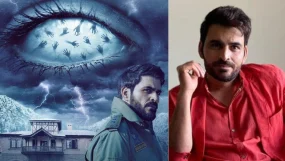
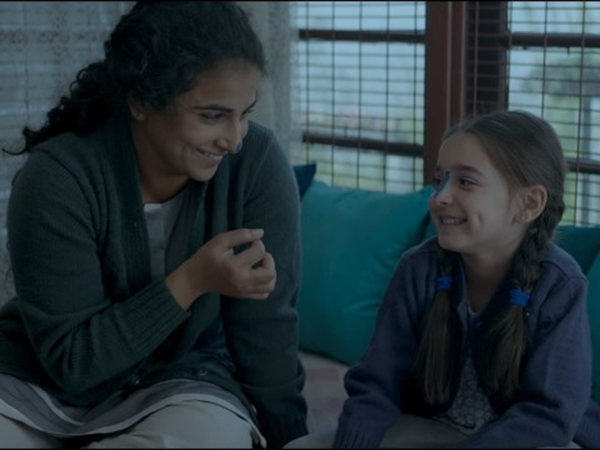
Recently released on Netflix, Aditya Suhas Jambhale’s supernatural horror thriller Baramulla impressed the audience with its story, performances, music and technical capabilities. Starring Manav Kaul and Bhasha Sumbli in the lead roles, the film beautifully blends the trauma of Kashmir with a missing-children investigation.
Bollywood Bubble recently interacted with the film’s musical team, Shor Police aka Clinton Cerejo and Bianca Gomes, and quizzed them about the film. From revealing how Shor Police formed to how they got he Aditya Dhar backed drama, composing the tracks and the difficulties involved in the making, the duo didn’t hold back. Read on to know all they shared.
SHOR POLICE Duo Clinton Cerejo And Bianca Gomes On Baramulla, Composition The Film’s Music & More
Before we talk about the music of Baramulla, can you both tell me how SHOR POLICE happened and how you guys zeroed in on the name.
Bianca: So when Clint and I decided we wanted to join a band together, we wanted to think of a fun name. Something that, because we wanted to, Clint wanted to break away from doing the folk music that he was into for so many years. And he just wanted to do something different. Wanted it to be more pop, wanted it to be more fun. And so we were thinking of a name and…
Clinton: Yeah, and obviously while bouncing around so many names, we went to my wife, Dominique, who also happened to provide us a name for our earlier project, which was a fusion project. And she came up with a name called Anantal, which we both loved because Anant means infinity and Tal means rhythm. So it’s a perfect name for a fusion band. And so this time, because we wanted to be so pop and fun, she came up with the name Shore Police and we instantly connected with it because…
We’ve all played Chor Police as children and it has a ring of nostalgia and it has a completely fun vibe. The minute you think of Chor Police, you think of fun. So this is Chor Police because we love to make Chor on stage and in the studio. So Chor Police felt very apt for us.
Baramulla is a very different film when it comes to how it spoke about Kashmiri Pandits, the volatile situations in Kashmir and the bonds between family members. What was you first thought when Aditya Dhar and team approached you guys for the background score and film songs?
Clinton: Initially, we had a couple of other projects going on and the fact that this was coming bang in the middle of gig season as well we actually said no to this because we felt that we wouldn’t have as much time and given the fact that it was Aditya Dhar’s film, we both loved Article 370 so much that we really wanted to put our best foot forward when working with him for the first time and we actually said no to this because we thought that we wouldn’t have enough time in between all our gigs and the fact that we were already in the middle of another film project as well.
But, you know, I mean, we just love B62 Studios and everybody from that team and Aditya Dhar and Lokesh and literally everyone from B62 Studios. We just love working with them. And they ended up convincing us to be part of the film, even though the timeline was really very, very crunched. And because the subject matter was so stark when we saw the film, nothing prepared us for how genre-bending it is in terms of how it takes a delicate subject and it doesn’t beat your head with it. It kind of just weaves around such a beautiful story and really immerses you into Kashmir as a troubled land. And everything. So it was really a layered script. And that’s what kind of drew us in so much to want to do this film and be extremely excited to be a part of it.
Bianca: Yeah, so when we saw the film, it was very important for us to be able to represent the mood of Baramulla in our music and the compositions, the songs, the score, everything. Because the landscape is just so breathtaking. The film has so much… so layered and so emotional that we realized that it wasn’t really about religion. It was more about this family, it was about values. It was about emotion at the end of the day, which needed to translate through our music. So we really wanted to convey that based on the imagery that you were seeing in the film.
Out of the three original tracks you two composed, which was the most difficult (both your answers can vary), and which has a very special place in you heart/a fond memory you have attached to its creation/recording.
I think for me, it was probably the first song that we created, which was Neend Ke Shikare for the film, which comes at the end of the song, beautifully sung by Shilpa Rao. This one was originally taken from an old Kashmiri folk song, which is Hocus Pocus. Now, when we found out it had to be a remake of that, it was a little confusing to us as to how we were going to proceed because… The song is very cheerful. The song is loved by everyone. It’s a very sing-along kind of song. But yet in this context, it was completely different. It was a lullaby that was sung to a child by her mother. It had to be emotional. I mean, it was quite heavy and melancholic and all of that. So it was quite a task in our heads to figure out, okay, how do we make this emotional?
Yeah. And how are people going to respond to this? Because they’re so used to this melody, which is always so bubbly. So, but I think it’s really turned out well. And lyrically and also vocally, Shilpa has done such a beautiful job executing this lullaby. And she’s really stuck to the brief so beautifully and added her amazing texture, which really gave the lullaby exactly the emotion that it required. Yeah, and for me, I think it’s such a toss-up between the song that Krishna Bhiora sang, which was Phir Se Dikhe, because he’s brought so much life to the song and he’s just done so much of a very classic, rustic folk vibe that people who love the genre would totally connect with.
But I have to say, maybe just a tad more, maybe leaning towards the last song that we did, primarily because… it was totally something that took us out of the sonic scape of the whole film that we had been living with for weeks because that was extremely, you know, using acoustic instruments and this was very electronic and we decided to very consciously move away from sonically whatever we had done in the film and to create a song that maybe that probably doesn’t fit sonically with the film but yet becomes a really nice promotional tool for the film because when you place it against the visuals of the film it totally you know adds a very different color to the same visuals that we have seen in the film so I really love that and also the fact that we were able to bring A Rabab hook which we have used in the film very effectively to bring that in the song and weave the whole song make that the centerpiece of the song was kind of coming full circle in a way which is why I really loved that process as well.
Do you think its more difficult to provide music for horror films as compared to say a rom-com or a romantic films?
Clinton: Yes. Horror is a very very different genre. It’s very very dependent on background score. To make people scared… and to give people to instill fear in the hearts of an audience is not an easy thing and it’s very very sound and music driven and music that is not your regular music because it you have to always move away harmonically from the scales you would normally use you would have to use a lot of dissonance and that’s not something that composers can do very easily you have to have some you know knowledge of theory and be able to try to call on that whenever you’re working on I think a horror film if you want to be musically consistent with the genre. So that’s the difficult thing. And secondly, of course, you have to be a horror buff. And it’s something that not everyone can stomach horror films to begin with as viewers, as an audience. So when you’re composing, first of all, you have to overcome your fear of horror films in the first place, which is something that took me a very, very long time to do.
The good part is that my partner, Bianca, is such a horror buff that it really, really helps and helps to take the collective horror quotient up by several notches. Yeah, I think you understand how important music is to a horror. When you watch a film, especially when you’re about to score it, before you score it, you’re watching that film without anything. You’re watching it without, you’re only watching the scenes without any music. So you’re really not prepared for what’s happening. And even when it does happen, you’re like, oh, okay. Right?
But when you actually watch it with music for the first time, you realize that with horror, what you’re doing is you’re prepping the audience for what’s about to happen before it happens. In the case of a rom-com, you’re usually following the humor and then you’re sort of punctuating what has happened after it’s happened, right? So if there’s something like a joke or something like that, there’ll be something cheerful in the music That’ll happen after that moment versus a horror which will happen before that moment.
So it’s sort of prepping the audience and the audience doesn’t even know. what’s happening to them all they know is that they’re getting stressed out and they’re uneasy and at the edge of their seat and that uh there’s there’s a lot of power in the music score in the background score because of that so it’s very important for you to lead your audience in a horror versus a rom-com where you don’t really require uh any sort of pre work in that case yeah
For more news and updates from the entertainment world, stay tuned to Bollywood Bubble.
Also Read: Baramulla REVIEW: Manav Kaul’s Horror Film Merges Horror And Small Town Tales With Skill, Nuance And Heart

With nearly 10 years of experience, Grinell Esther Jacinto is the Desk Head of Bollywood Bubble. Her interests lie in everything that is kaleshi and she loves to dig deeper into the lives of B-town actors. She has a problem though – she loves horror films but will have chills the minute the theatres lights dims. She’s previously worked with Koimoi, UrbanAsian and SpotboyE.
Related Posts

EXCLUSIVE: Ron Kariappa Hits Back At Asmita Adhikari’s Allegations Of Flirting With Akanksha Choudhary On Splitsvilla X6; Says, “I Went To Splits To Have Fun”

EXCLUSIVE: Hirav Mehta Defends Dhurandhar The Revenge Amid Propaganda Claim; Calls Ranveer Singh Starrer ‘Powerful Anti-Terror Film’

EXCLUSIVE: ‘BUF Member’ Hirav Mehta REACTS To Being Tagged ‘India’s Best Driver’ Following Dhurandhar The Revenge Performance; Says, “Script Padke I Was Like…”

EXCLUSIVE: Ron Kariappa BASHES ‘Other Kids’ From The Splistvilla X6 For Going Live On Social Media To Prove Their Side; Says, “I Am Not Afraid Of You Calling Me An A**hole”
Recent Post
- Kritika Kamra- Gaurav Kapur Reception: Malaika Arora, Vidya Balan, Richa Chadda And Many Celebs Attend The Newlyweds’ Star-Studded Celebration

- Ramesh Taurani Diwali Party 2025: Hrithik Roshan-Saba Azad, Riteish-Genelia Deshmukh, Sonakshi Sinha-Zaheer Iqbal And Other Bollywood Celebs Glam Up Ahead Of Festivities
- Manish Malhotra Diwali Party 2025: Nita Ambani, Radhika Merchant, Kareena Kapoor, Karan Johar And Other Bollywood Celebs Dazzle In Their Festive Finest

- The Ba***ds Of Bollywood Screening: Ranbir Kapoor-Alia Bhatt, Vicky Kaushal, Ambanis And Many More Celebs Step Out In Style To Support Aryan Khan’s Directorial Debut

- Son Of Sardaar 2 Screening: Mrunal Thakur, Ravi Kishan, Kubbra Sait, And Other Bollywood Celebs Attend Ajay Devgn’s Comedy Drama Premiere
- Metro…In Dino Screening: Aditya Roy Kapur, Sara Ali Khan, Anupam Kher, Neena Gupta And Other Bollywood Celebs Attend Anurag Basu’s Romantic Drama Premiere
- Naagin 6 Fame Simba Nagpal’s THESE Photos Prove He’s The Ultimate Adventure Junkie

- Met Gala 2025 Worst Dressed: ‘Basic’ Hailey Bieber To ‘Barbie’ Shakira And ‘Witchy’ Sadie Sink, 12 Celebs Who Pissed The Fashion Police

- Met Gala 2025 Best Dressed: Pregnant Rihanna To Princey Diljit Dosanjh And Mesmerizing Jodie Turner-Smith, 12 Celebs Who Wowed Us With Their Fashion
- Phule Special Screening: Javed Akhtar, Rajkummar Rao, Huma Qureshi And Other Celebs Arrive To Support Pratik Gandhi, Patralekhaa-Led Biopic




Read More

Follow us
© 2026. All rights are reserved with DeepDive Digital Pvt Ltd