
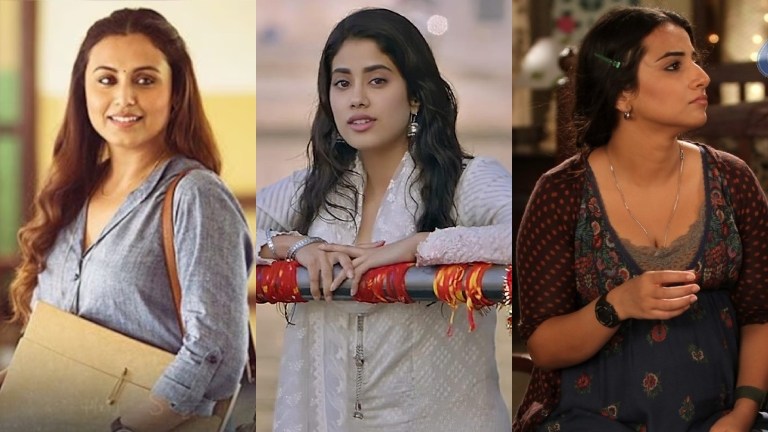
There was a time in Hindi cinema when “being a girl” was associated with limitations and compromises. But some actresses redefined this very notion through their roles, mindset, and fearless choices. They proved that sensitivity is not a weakness, but another name for confidence, decision-making ability, and courage. So, on the occasion of National Girl Child Day, let’s take a look at those actresses who became an inspiration for audiences through their films.
Bollywood Actresses Who Turned ‘Being A Girl’ Into Their Strength
Vidya Balan
Vidya Balan broke the myth that there is a fixed template to become a heroine. Through films like Kahaani, The Dirty Picture, and Sherni, she placed independent, strong, and thoughtful women at the center of the narrative—without any compromise.
Kajol
Kajol brought empowered female characters into the mainstream as early as the 1990s. In films like Dushman and Fanaa, her emotional strength and decision-making ability showed that a woman can be strong in every role—be it a mother, a lover, or a wife.
Rani Mukerji
With films like Black, Mardaani, and Hichki, Rani Mukerji gave a new definition to female power. Her characters became symbols of leadership, compassion, and determination, where “being a girl” emerged as a strength in itself.
Kangana Ranaut
From Queen to Tanu Weds Manu, Kangana portrayed women who chart their own life paths. Her boldness turned “being a girl” into an identity of fearlessness and self-reliance.
Janhvi Kapoor
From Dhadak to Gunjan Saxena: The Kargil Girl and Mili, Janhvi Kapoor chose roles that are emotionally strong, confront fear, and refuse to bow to circumstances. In Gunjan Saxena, she showed that a girl’s dreams can touch the sky, while Mili portrayed survival and mental resilience with great simplicity.
Alia Bhatt
At a young age, Alia Bhatt proved that emotional depth itself is a great strength. In Highway, Raazi, and Gangubai Kathiawadi, her characters appear sensitive yet incredibly strong.
Deepika Padukone
Through films like Chhapaak and Padmaavat, Deepika presented examples of courage, dignity, and self-respect. By speaking openly about mental health, she has also become a powerful voice for millions of girls in real life.
Priyanka Chopra Jonas
Priyanka stepped beyond the boundaries of Indian cinema to create a strong global identity. At the same time, through Mary Kom, she showed that a girl has every right to dream and fulfill those dreams—and that she can achieve anything she sets her mind to.
Taapsee Pannu
In films like Pink and Thappad, Taapsee gave a voice to women who refuse to stay silent, question injustice, and stand up for their self-respect.
Madhuri Dixit
Gulabi Gang, Lajja, and Mrs. Deshpande are powerful women-centric projects in which Madhuri Dixit used her voice to stand up for women and their rights. Through these films and series, she portrayed characters who challenged patriarchy, spoke against injustice, and highlighted issues faced by women across different social backgrounds.
All these actresses, in their own eras, proved that a woman alone has the right to define herself. Today, the woman in Hindi cinema is not just a part of the story, but the force that shapes its direction—because now, “being a girl” is not a weakness, but a strength.
For more news and updates from the entertainment world, stay tuned to Bollywood Bubble.
Also Read: Makar Sankranti 2026: Ambarsariya, Udi Udi Jaye To Pathakha Guddi, 6 Bollywood Songs That Should Be A Part Of Your Kite Flying Festival Playlist

Akankshya Mukherjee is a dynamic and ambitious individual poised to make waves in the realm of Media and Communication. With a passion for creativity and a drive to contribute to forward-thinking organizations, Akankshya embodies adaptability and a hunger for learning. Having already garnered experience through involvement in various organizations, she has honed the skill of quickly adapting to new environments and challenges. She sees each opportunity as a chance for personal and professional growth, eagerly embracing roles in communications and content writing.
Related Posts
Nana Patekar Death: Bhagwan Ka Diya Hua Sab Kuch Hai To Ek Machchhar Saala Aadmi Ko Hijda Bana Deta Hai, Most Unforgettable Dialogues Of The Veteran Star
Drishyam The Conclusion, Udta Teer, Prem Keetanu To Prahaar, Nayyi Navelli – 7 Movies To Watch In Theatres This October

Pain Auction To Harsh Gujral, Orry Surprising Fans And Rohit Shetty Being The Ultimate Mentor- 5 Moments That Made Khatron Ke Khiladi 15 A Blockbuster Season
Bigg Boss 20: Scout OP-Arishfa Khan’s Heated Clash, Mahhi Vij-Amrapali Dubey’s Kitchen Drama To Rhiti Tiwari-Qazi Touqeer’s Fight Over Fake Medical Emergency, 5 Recent Fights That Have Changed The House Dynamics
Recent Post
- Anshula Kapoor-Rohan Thakkar Wedding Reception: Boney, Anil, Sanjay, Arjun, Janhvi, Shanaya Kapoor And More Bollywood Celebs Arrive In Style

- Devil Wears Prada 2 Screening: Karan Johar, Rhea Chakraborty, Tamannaah Bhatia, Pratibha Ranta And Others Turn The Red Carpet Into A Fashion Extravagance
- Kritika Kamra- Gaurav Kapur Reception: Malaika Arora, Vidya Balan, Richa Chadda And Many Celebs Attend The Newlyweds’ Star-Studded Celebration
- Ramesh Taurani Diwali Party 2025: Hrithik Roshan-Saba Azad, Riteish-Genelia Deshmukh, Sonakshi Sinha-Zaheer Iqbal And Other Bollywood Celebs Glam Up Ahead Of Festivities
- Manish Malhotra Diwali Party 2025: Nita Ambani, Radhika Merchant, Kareena Kapoor, Karan Johar And Other Bollywood Celebs Dazzle In Their Festive Finest
- The Ba***ds Of Bollywood Screening: Ranbir Kapoor-Alia Bhatt, Vicky Kaushal, Ambanis And Many More Celebs Step Out In Style To Support Aryan Khan’s Directorial Debut

- Son Of Sardaar 2 Screening: Mrunal Thakur, Ravi Kishan, Kubbra Sait, And Other Bollywood Celebs Attend Ajay Devgn’s Comedy Drama Premiere
- Metro…In Dino Screening: Aditya Roy Kapur, Sara Ali Khan, Anupam Kher, Neena Gupta And Other Bollywood Celebs Attend Anurag Basu’s Romantic Drama Premiere
- Naagin 6 Fame Simba Nagpal’s THESE Photos Prove He’s The Ultimate Adventure Junkie
- Met Gala 2025 Worst Dressed: ‘Basic’ Hailey Bieber To ‘Barbie’ Shakira And ‘Witchy’ Sadie Sink, 12 Celebs Who Pissed The Fashion Police




Read More
Follow us
© 2026. All rights are reserved with DeepDive Digital Pvt Ltd