

Film:
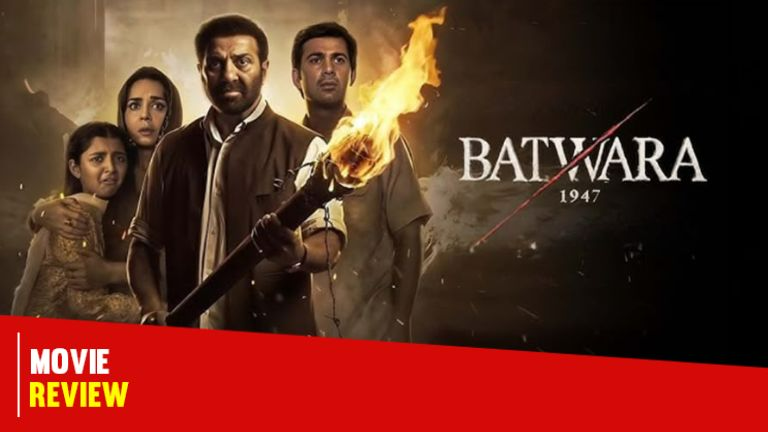
Batwara 1947
Bubble Rating:

Director: Rajkumar Santoshi
Writer: Rajkumar Santoshi, Asghar Wajahat
Cast: Sunny Deol, Preity Zinta, Shabana Azmi, Karan Deol, Ali Fazal, Abhimanyu Singh, Khushi Hajare, Kanikka Kapur and Isha Sandhir
Platform: In Theatres
Runtime: 2 hour 25 minutes
Batwara 1947 Review
Partition is one of the most painful chapters in the history of India and Pakistan, and stories set against that backdrop automatically carry a certain emotional weight. Rajkumar Santoshi’s Batwara 1947 attempts to explore the trauma of displacement, loss and human connection through a family caught in the aftermath of Partition. He keeps pulling us away from history-book headlines and towards people. A home that someone refuses to leave. A mother waiting for a son who may never return. A family discovering that compassion can sometimes demand more courage than violence.
Set in Lahore in the Punjab region, the story begins after the newly independent nations of India and Pakistan are overwhelmed by millions of uprooted refugees. Families who have lost their homes are forced to rebuild their lives in unfamiliar surroundings. Among them is Sikander Mirza (Sunny Deol), who moves from Lucknow to Lahore with his wife Hamida (Preity Zinta), son Javed and daughter Tanvir.
After spending time in a refugee camp, the Mirza family is allotted a large haveli abandoned by its Hindu owners. However, their new beginning takes an unexpected turn when they discover an elderly Hindu woman, Mai (Shabana Azmi), still living there. She refuses to leave and insists that the haveli belongs to her family. What follows is a clash between two families who have both lost everything, creating an emotional conflict around ownership, identity, displacement and survival in the surrounding area.
What Works
The biggest strength of Batwara 1947 is its subject. The partition drama tries to look at Partition beyond the usual political narrative and focuses on ordinary people who were forced to leave behind their homes, memories and identities.
Shabana Azmi brings tremendous dignity and emotional depth to Mai. Her character carries the pain of someone who has lost almost everything, and Azmi makes those moments believable. The central conflict between Mai and Sikander also gives the film some of its strongest scenes. A Muslim man and an elderly Hindu woman, technically separated by everything Partition wants them to be separated by, slowly become family.
Rajkumar Santoshi’s direction attempts to underline the shared pain of people on both sides of the border works well. It reminds us that partition did not simply divide a country; it shattered families and forced people to start their lives from scratch.
Technical Analysis
Rajkumar Santoshi and Sunny Deol have made angry cinema together before. Here, that anger seems older, wiser and more compassionate. Technically, Batwara 1947 manages to recreate the atmosphere of a turbulent period reasonably well. The production design and costumes help establish the period setting, while the cinematography captures the bleakness and uncertainty surrounding the characters.
However, the overall pacing could have been tighter. The film occasionally loses momentum, particularly when the story moves away from its central emotional conflict. The background score complements the dramatic portions, but the film sometimes pushes its emotions rather than allowing them to develop naturally.
The biggest technical drawback remains the writing. A subject as emotionally loaded as Partition deserved a more layered and consistently engaging screenplay.
Star Performances
Sunny Deol as Sikander Mirza brings his trademark intensity to the role. He is just tremendous. People will understandably wait for the dialogues, the anger, the voice and those moments where the theatre responds instinctively to his presence.
Preity Zinta as Hamida Mirza is sincere and restrained. She brings warmth and familiarity, but she is not there merely for nostalgia. Her presence adds warmth to the family dynamic, although the role is comparatively underwritten.
Shabana Azmi as Mai is the standout. She brings gravitas, vulnerability and strength to the character, making Mai’s pain feel authentic without overplaying it. She refuses to behave like a symbolic victim created merely to make us cry. She feels alive. She has opinions, habits, memories and a home she considers hers irrespective of what politicians or borders may now say.
Karan Deol as Javed Mirza deserves a special mention. Acting opposite Sunny Deol is difficult enough; doing it while also carrying the inevitable comparison of being his son must be harder still. Yet Karan stands his ground. His dialogue delivery has conviction; there is confidence in his confrontation scenes, and importantly, he never appears to be performing an imitation of his father. He finds his own rhythm.
Ali Fazal as Habib Kazmi adds another layer to the narrative. He appears with a completely different energy, as gentle, thoughtful and almost poetic. His scenes with Sikandar Mirza have a quietness that contrasts beautifully with the violence surrounding them.
Abhimanyu Singh as Yaqoob Pehalwan makes his presence felt in a villainous role. He is suitably threatening, becoming the face of the hatred that the film is ultimately arguing against.
The supporting characters make Batwara feel larger than the story of one star. This is an ensemble film in the true sense. Khushi Hajare as Tanvir Mirza is effective, while the supporting cast, including Kanikka Kapur, Isha Sandhir, Khalid Siddiqui, Rukhsar Rehman, Parminder Singh Kainth, Shivika Rishi, Ambika Nagwani, Pankaj Raina, Rajan Modi and Chandan Dilawar, contribute adequately to the story.
Conclusion
Countries can be divided. Homes can be divided. Land can be divided. Humanity does not have to be. Batwara 1947 has a powerful story at its heart and attempts to approach partition through the deeply personal experiences of people who were forced to leave their homes. Shabana Azmi’s performance and the film’s central conflict work in its favour.
However, uneven writing, familiar characterisation and inconsistent pacing prevent it from becoming the moving Partition drama it could have been. The film has its heart in the right place, but the execution does not always match the magnitude of its subject.
Watch the trailer of Batwara 1947 here:
Also Read: Ohh My Dog REVIEW: Maahi Rai, Pankaj Tripathi’s Decent Dog Tale Is All Bark And No Bite
Related Posts

Love Lottery REVIEW: Akshay Oberoi, Heli Daruwala’s Love, Marriage & Gender Debate Fail To Strike The Right Chord

The Vvaan REVIEW: Sidharth Malhotra, Tamannaah Bhatia’s Folklore Fantasy Delivers Chuckles, Thrill And Devotion

Hunkkaar: The Roar REVIEW: Aneet Padda, Raghubir Yadav, Fatima Sana Shaikh Bring A Slow-Burning Narrative That Fails To Roar

Don’t Be Shy REVIEW: Aarushi Bajaj, Piyush Khati, Bianca Arora & Ansh Duggal’s Performances Get Lost In A Bland & Predictable Storyline
Recent Post

- Anshula Kapoor-Rohan Thakkar Wedding Reception: Boney, Anil, Sanjay, Arjun, Janhvi, Shanaya Kapoor And More Bollywood Celebs Arrive In Style

- Devil Wears Prada 2 Screening: Karan Johar, Rhea Chakraborty, Tamannaah Bhatia, Pratibha Ranta And Others Turn The Red Carpet Into A Fashion Extravagance

- Kritika Kamra- Gaurav Kapur Reception: Malaika Arora, Vidya Balan, Richa Chadda And Many Celebs Attend The Newlyweds’ Star-Studded Celebration

- Ramesh Taurani Diwali Party 2025: Hrithik Roshan-Saba Azad, Riteish-Genelia Deshmukh, Sonakshi Sinha-Zaheer Iqbal And Other Bollywood Celebs Glam Up Ahead Of Festivities

- Manish Malhotra Diwali Party 2025: Nita Ambani, Radhika Merchant, Kareena Kapoor, Karan Johar And Other Bollywood Celebs Dazzle In Their Festive Finest

- The Ba***ds Of Bollywood Screening: Ranbir Kapoor-Alia Bhatt, Vicky Kaushal, Ambanis And Many More Celebs Step Out In Style To Support Aryan Khan’s Directorial Debut

- Son Of Sardaar 2 Screening: Mrunal Thakur, Ravi Kishan, Kubbra Sait, And Other Bollywood Celebs Attend Ajay Devgn’s Comedy Drama Premiere

- Metro…In Dino Screening: Aditya Roy Kapur, Sara Ali Khan, Anupam Kher, Neena Gupta And Other Bollywood Celebs Attend Anurag Basu’s Romantic Drama Premiere

- Naagin 6 Fame Simba Nagpal’s THESE Photos Prove He’s The Ultimate Adventure Junkie

- Met Gala 2025 Worst Dressed: ‘Basic’ Hailey Bieber To ‘Barbie’ Shakira And ‘Witchy’ Sadie Sink, 12 Celebs Who Pissed The Fashion Police






Read More




Follow us
© 2026. All rights are reserved with DeepDive Digital Pvt Ltd